Let me ask you something. Do you remember the last time someone taught you how to make a decision? Me neither. And I find it weird, because we make hundreds of them every day. We should be experts by now, but we are not. Let me explain why this is a problem.
Wise people use mental tools to make decisions. I have read hundreds of them, but there is one that few people talk about. I like it because it is simple to apply and yet very powerful. So let me show you how it works.
Let's say you decide to buy a TV for the bedroom.
That's the whole decision. You didn't have one, the room felt a little empty, and a screen on the wall seemed like a nice thing to have. Nobody would call that a mistake. It's one of the most reasonable purchases a person can make.
Then, a few nights later, you're watching Netflix in bed. Just one episode. Then two. You fall asleep later than you meant to. The next morning you're tired, so you skip the gym, or you drag through the workday running on half a tank. A week of that and your sleep is wrecked, your training has stopped, and your work is slipping. You feel it. Something is off and you can't quite name it.
So you go looking for the cause. Maybe it's stress. Maybe you need a better morning routine, a supplement, a new alarm. Maybe a new job? What is it? You look for the problem in the place where the damage showed up.
But the bad sleep isn't the cause. It's the symptom. The cause was the TV. A decision you made weeks ago, one that looked completely harmless. You never chose to sleep badly. You never chose to quit the gym. You chose to buy a TV, and everything else followed on its own.
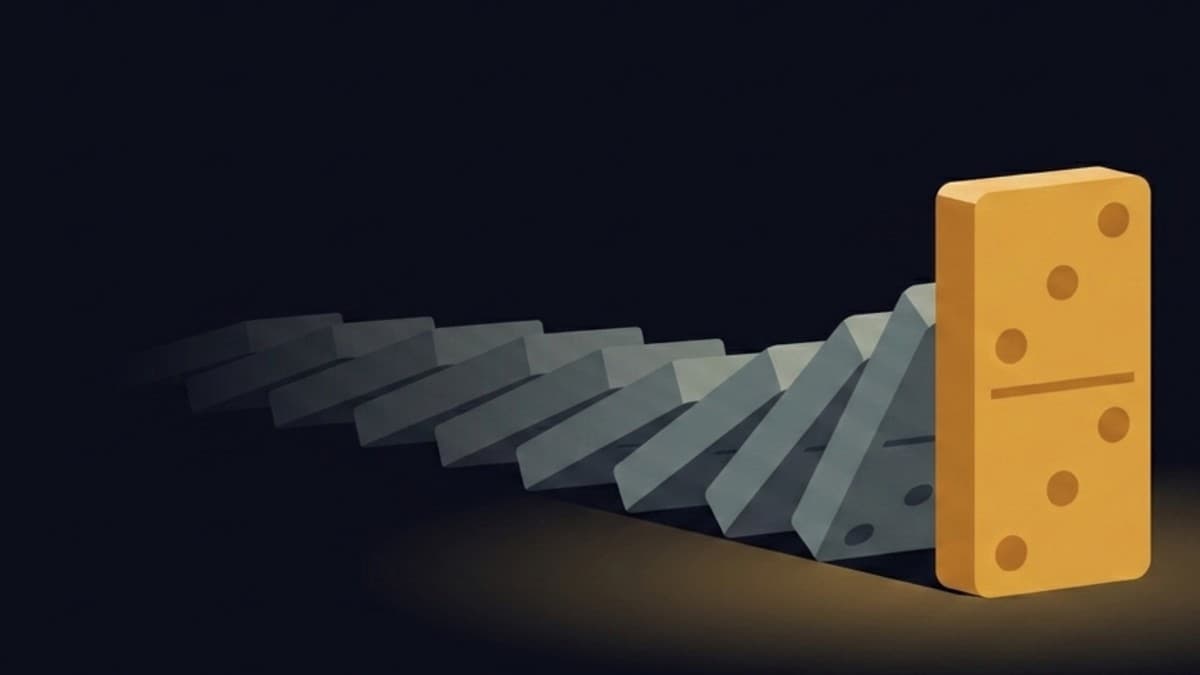
This is called second-order consequences. Every decision you make has a consequence, and that consequence has its own consequence, and that one has another. The problem is that we fail to think past the first. You decide to buy a TV, you picture a nicer bedroom, and you stop there. You never follow the chain reaction of that decision, one domino tile knocking over the next, and the next, and the next. And here's the trap.
After a decision, the tiles fall forward until the last one lands, and by then the consequence is loud enough that you finally go looking back to find what caused it. But searching for the cause, you stop too soon. Just as we stop too soon looking forward when we decide, we stop too soon looking backward when we search. And here is the real danger.
When you go looking for what went wrong, you could end up changing something that had nothing to do with it. Now that your sleep is a little wrecked, you underperform at the job. You are not getting good results, so you start to feel unmotivated. Then your boss calls your attention to it, and you feel miserable. Who wouldn't? So you decide you can't stand this anymore, and you figure the whole problem is the job, or the boss, and you quit.
You changed something that was never the answer. The real problem was further behind, still sitting in your bedroom, still running. So you change the wrong thing, and nothing gets better, because the first tile never moved.
And here's why we never catch it. The choice is small and visible, but the consequences are large and hidden, and they show up so much later that we never connect them back to the thing that started them.
It's like a row of dominoes. The first one falls, then the next, then the next. By the time we reach the last one, we finally notice something's wrong. Usually too late. The damage is already done.
But every one of those falling tiles was decided by the first. That one you could have stopped. The one still standing, that you could hold in place with a single finger.
That's where all the leverage is. Not in fixing the tired mornings. Not in dragging yourself back to the gym on no sleep. It's in the one small decision at the very front, the one that looked too harmless to matter. Let's see it with another everyday example.
You need to do some work. You set up your desk, you make your best cup of coffee, everything ready to do your best work. Then your phone buzzes with a notification, so you check it. And while you are there, you open social media. You scroll once, then again, and again. Forty-five minutes later you are still on the phone.
What was the issue here? Let's trace it backwards. Checking the phone? Leaving your notifications on? Not blocking certain apps? Or maybe, further back, why was your phone on your desk in the first place? Why not leave it in another room?
I believe you already get the point, and you already know some of your own first tiles. The trick is to keep this habit with you. We have all been two hours into a podcast and then wondered why we didn't use that time for something better. It's practice. By repeating the question, what is the consequence of the thing I am about to do, you will build a mindset of focus and priorities, and your life will get better.
Just remember, you don't need to see the whole chain coming. You can't. Nobody can. You just have to find the first tile, and leave it standing.