Have you ever wondered why your mind acts more like an enemy than an ally? It is supposed to help us. So why does it so often feel like it doesn't? We have all felt it before.
You have a presentation tomorrow. Immediately, your mind starts imagining everything that could go wrong. What if the slides don't load? What if you freeze? What if someone asks something you can't answer? Your heart speeds up, and your body drops into battle mode, like something is about to attack. The mind should calm you. Instead it makes you panic.
Which would make sense, if you were in danger. That reaction is built for a predator. The racing heart, the adrenaline, all of it is your body trying to keep you alive. But the predator never shows up and the feeling comes anyway. You can be in your kitchen on a quiet morning, ready to fight a bear that will never come.
We think we choose our thoughts. That if we are worrying, rehearsing the failure, running the worst case, it is at least a decision we are making. We go further than that. We turn the thoughts into an identity. This is just who I am. I am an anxious person. So we stop questioning it. I used to think the same. Of course I choose my own thoughts. But then I learned something that blew my mind and changed how I see my thoughts.
I will oversimplify the biology here, so do not go hard on me. Picture each cell as a little box with holes in it. Each hole is a door, and through those doors the cell takes in what it needs. Now, when you feel anxious often enough, the new cells your body builds start arriving with more doors for the anxiety. More doors, more ways to let that one feeling in. Soon you have a whole army of cells, each one built with extra doors open, waiting. You supply the anxiety, they take it in. Everyone is happy.
But then something strange happens. Your life goes calm. Nothing is wrong. And those cells sit there with all their doors open and nothing coming through. What a waste, they think. We built all of this. So they send a message back up to the brain: find us something to worry about.
And there you are, having a good meal, calm and relaxed. Then a small fear hits you out of nowhere. Did I bring my wallet? Both hands are already patting every pocket before you even decide to. You did not choose that thought. Your body ordered it up, because the worry was never really about the wallet. It was about feeding the doors you spent so long building.
That is how your body hands you a thought you never chose, and makes it feel like it came from you. But here is the good news. If the pattern can be built, it can be broken. Let me show you how.
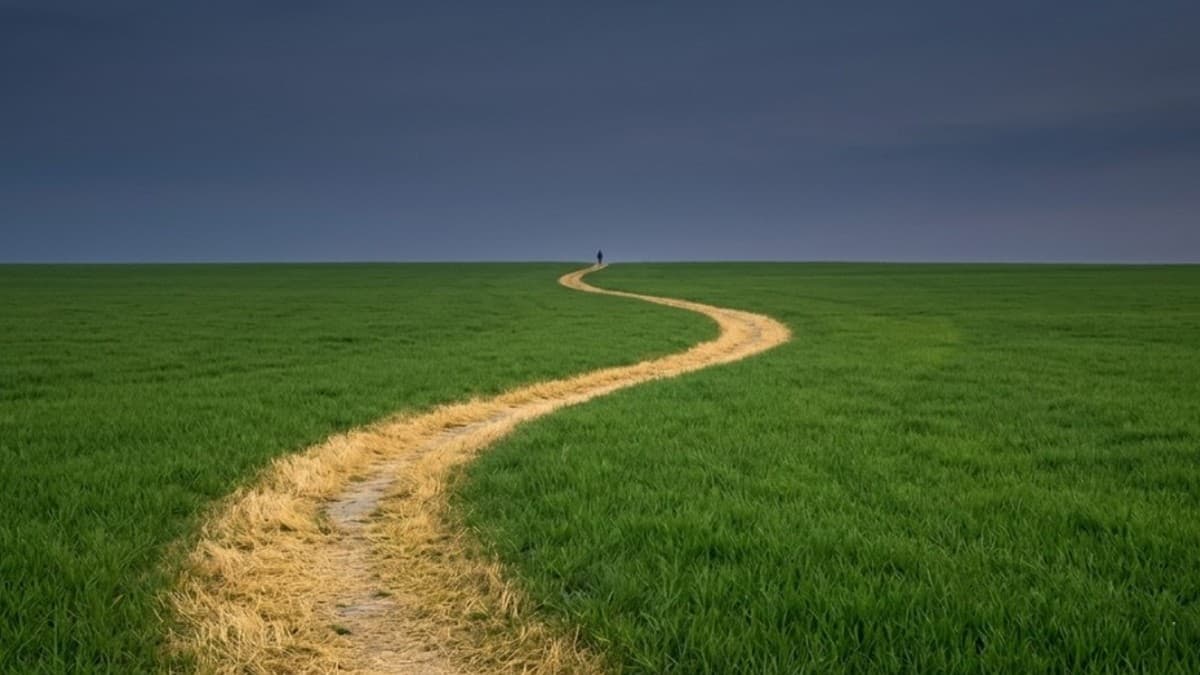
Picture a path through tall grass. The first time you walk it, you have to push through. But walk the same route a thousand times and there is no grass left to push, just a trail worn smooth, and your feet take it before you decide to. That is what a repeated thought becomes. A trail so worn you mistake it for the only way across.
And that trail is not just a picture. It is real, worn into your brain. It starts there, with a feeling, running the same route again and again until the neurons fire together and the wiring between them grows smooth. That is step one. Then your body follows. Below the brain, your cells take the repeated signal as an order and build themselves to match it, fitted for the anxiety you keep sending down. And once they are built, they send the signal back up, asking for more. The thought made the body, and now the body asks for the thought.
The trail is the trap, but it is also the way out. You cannot erase the old path overnight. If you walked it for years, it will not disappear in a week. But it does fade, slowly, in proportion to how long you spent wearing it in. What you do is start walking a new one. And the first hundred times, it is miserable, because there is no trail yet, just grass, and the old smooth path is right there calling you back. And it is hard, because you have to catch the thought consciously, in the moment, before it slips back into the automatic groove it always takes. Choosing peace, or gratitude, or even just noticing you have a choice at all, is not soft. It is you pushing through unwalked grass while everything in you wants the easy trail.
But grass grows back over a path nobody walks. Slowly, the old trail fades. And the new one, the one that took so much effort at first, wears smooth. One day you cross the field the new way without thinking about it. Not because the old path is gone, but because you stopped walking it long enough for the grass to close.
So start walking. The trail is yours to make.